

Cheap Compute, Multiplying Contract Disputes
Three Ways Out of the AI Consumer Arms Race

Last week I described the AI-mediated consumer dispute equilibrium as an arms race that wastefully redistributes surplus. A reader’s follow-up question pushed me to think harder about where I ended up.1
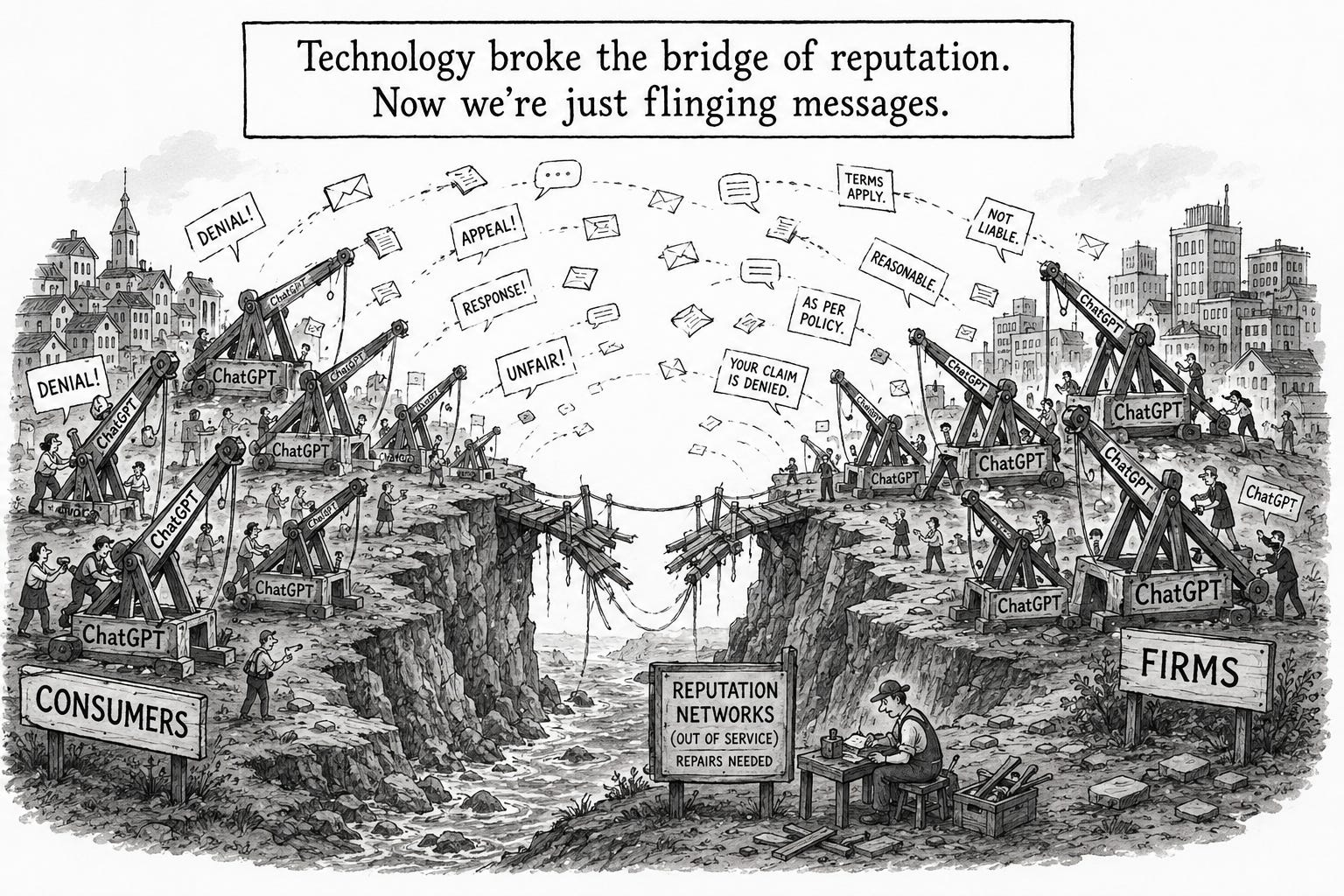
I argued that firms and consumers are starting to engage in bot-vs-bot escalatory campaigns around post-contract disputes. As those exchanges heat up, there will be changes in the drafting of consumer contracts, and a slight shift of power toward firms, but without any obvious corresponding welfare benefits. We’ll be burning surplus fighting about the meaning of unread consumer contract terms like “timely” and “reasonable.”
That cycle of escalation seems inevitable because the kind of compute necessary to fight about consumer contracting is, at the margin, approximately free. The asymmetry that used to favor firms — they could afford lawyers, consumers couldn’t — has been reversed by AI. Consumers can now afford near-zero-marginal-cost legal-letter drafting, and firms will respond bot-for-tat.
On reflection, “compute is free at the margin” is not a stable property of the technology. It seems more like a transient subsidy. AI firms are currently selling compute below its long-run sustainable price, burning investor capital and infrastructure debt to acquire users and market position.2 Or at least it seems safe to predict that the marginal cost of compute we’re observing today is not the marginal cost of compute we’ll observe in three years.
Sam Altman’s now famous prediction — “We see a future where intelligence is a utility, like electricity or water, and people buy it from us on a meter” — was controversial on a number of dimensions, but captures the logic fairly well. Long term, compute is going to be a rate-limited infrastructure product, and some people are going to have the resources or ability to buy much more of it than others.
That implies that my prediction about the near-term future of consumer disputes is not the long-term AI-era equilibrium. It might be more of a passing phase in which mispriced inputs make rent dissipation the norm. So, the relevant question for institutional design isn’t “what discipline can be brought to bear on the current arms race” but “what discipline will be in place when the incumbent compute sellers begin to extract their rents.”
When that happens, I’d guess that the firm-side retains every advantage it has today, while the consumer side loses the temporary leverage AI subsidies gave it. Without architectural intervention, we end up with a worse equilibrium than the dissipative one we have now: firms with amortized compute budgets running near-costless delay and denial machines, and consumers that shift their compute power budget from consumer disputes to, say, figuring out how to turn on their super-smart toasters.
Why reputation isn’t going to help
So, we face a future either of burning compute on marginalia, or an even-more-tilted field against consumer rights. What’s to be done?
The traditional non-contractual answer to this kind of problem is reputation. Macaulay’s businessmen in 1963 governed their commercial relationships through repeat play and word-of-mouth, not through contract enforcement. Bernstein generalized this into a theory of network governance: reputational discipline works when bad behavior is detectable and information about it transmits through short network chains. Diamond merchants on 47th Street and cheese mongers in Wisconsin satisfied both conditions. With respect to firms post-contracting consumer service, mediated through their contract terms, modern markets (increasingly) satisfy neither.
One problem is that modern consumer goods are sold on fragmented platforms — Yelp, TikTok, the BBB — rather than through dense personal networks. Those platforms are themselves awash in AI-generated content: per Yelp’s own 2025 Trust & Safety Report, the platform filtered out roughly 500,000 suspected AI-generated reviews in 2025 and shut down more than a million policy-violating accounts, a 138% increase over 2024. Meanwhile, small businesses are now being extorted by AI-driven negative-review schemes operating out of overseas review farms. And firms have every incentive to bribe individual consumers to not complain. The signal-to-noise ratio is degrading faster than the platforms can clean it up.
The second failure is more fundamental. The classical relational-contracts story assumes the firm values future business with the same consumer or their immediate network. AI-mediated mass consumer transactions sever that link. A landlord with 30,000 units across twelve states cannot meaningfully care about a single renter’s individual exit decision. A national insurer’s claim handler will never interact with the same claimant twice. The threat consumers used to make — “I’ll tell my friends” — doesn’t scale even before we get to whether the platforms can keep the telling visible — and the fact that the platforms (X/Facebook/Bluesky/Youtube) themselves are unravelling into subcommunities makes the problem worse. The firm’s reputation pool is so large that any individual consumer’s signal is approximately invisible to it.3
As for mass arbitration, the plaintiffs’-bar response to all this? I’ve argued elsewhere that given the current structure of the mass arbitration and claiming system, we can’t rely on it to be a Ostromian self-governance success story.
That should leave us pessimistic that the normal non-legal routes to cabin exploitative firm behavior, or reduce the dissapation caused by bot-on-bot violence, will work. The question is what new institutional architecture, if any, could.
Reframing: this is an abundance problem
Let’s look at this from an abundance perspective.4 As I argued in November, the abundance question for private law isn’t “is this agreement fair?” or “would this distribution be just?” It’s a different question about fecundity: does the legal regime help produce what society needs, or does it dissipate the capacity to produce it? Here, what we need more of is private reputational discipline that can push back against this wasteful arms race. And those networks largely are missing because of how informatiion about consumer contract performance is fragmented.
If either the wasteful-compute or mispriced-compute diagnostic is right, then consumer law is in a pickle.
A natural response would be to argue for reinvigorated substantive intervention via UDAP authority once the federal apparatus is rebuilt. But we should be skeptical that you can harden federal regulations to survive our endlessly wild swings of political control. Even at the state level, substantive intervention runs into FAA preemption, depends on having the right people in office, and replays the surplus-distribution fight at a smaller scale.
An abundance alternative is architectural: blue-state regulators should stop trying to (just) pick the right distributional outcomes and start building the institutional substrate that lets other actors do the disciplinary work.5 The critical advantage of architectural moves is that they survive political reversal because they don’t depend on the regulator’s substantive preferences being right — they just depend on the data flowing and the intermediaries being functional.
Three possibilities follow. I’ll rank them from least to most politically implausible.
Building better data infrastructure
Many think Epic Systems v. Lewis (2018) was one of the most consequential employment law decisions of the last generation. It upheld class-action waivers in employment arbitration agreements under the Federal Arbitration Act. Earlier this spring, I got to wondering whether firms in jurisdictions that previously did / didn’t already enforce such waivers saw measurable changes in their employer-line insurance pricing after Epic. The theory would be that EPLI carriers are the real residual beneficiaries of decisions that (are said to) reduce the employment discrimination law’s expected liabilities.
This is the kind of question that ought to be answerable, and, though pre-trends are challenging, could have produced some actual knowledge of import. Identifying pass-through effects on their pricing would help us identify the real impact of decisions like Epic.
As far as I can tell, the data just isn’t available The National Association of Insurance Commissioners doesn’t publish EPLI pricing at this level of granularity, individual state insurance commissioners don’t either, the carriers have it but won’t share it.
So we can’t figure out, empirically, whether a major change in arbitration law had measurable consequences for insurance pricing of the relevant downstream risks. Does shunting employment law into arbitration benefit firms’ bottom lines? Who benefited from Epic, employers, employees, insurance firms’ shareholders? We can’t tell.
This is a public-policy failure that has nothing to do with whether you favor or oppose arbitration. It’s about being able to know anything at all about how a regulated market responds to a legal change.
The architectural move is straightforward: have states require and publish through NAIC mandatory machine-readable data on claim denials, denial categories, appeal outcomes, and pricing responses to regulatory changes, at a level of detail that allows later analysis possible.
State insurance commissioners are the natural target for this move: they already have submission relationships with carriers, they’re not federally politicized, NAIC produces model regulations that frequently get adopted across states, and California’s commissioner is independently elected. California is too big to segment out, so a California-led NAIC standard could become a de facto national rule..
Why not a state consumer {service} agency
Requiring NAIC to publish insurance data is a first step. But the idea of course expands beyond insurance law to other forms of consumer relations. Knowing about the wasteful bot-for-tat war that’s coming, and the limited compute era that will follow it, states should build public (data) goods that help reduce frictions currently impeding private regulation
California is actually about to launch — effective July 1, 2026 — a cabinet-level agency called the Business and Consumer Services Agency. As currently constituted, it’s a reorganization of existing licensing departments — DCA, DFPI, DRE, alcohol, cannabis, horse racing. As far as I can tell, it has no new mandate to advance consumer welfare.
But why not design that kind of agency as consumer welfare clearinghouse?
Cass Sunstein gave us the framework in his 2019 paper “Sludge Audits“ and his 2021 book Sludge: What Stops Us from Getting What We Want and What to Do About It. The Biden administration operationalized it as the “Time Is Money“ initiative in August 2024, going after hold times, cancellation flow doom loops, chatbot runarounds, and friction-laden insurance forms. The FTC tried the substantive version with click-to-cancel, though that’s now vacated. State click-to-cancel laws are proliferating (CA, NY, CO, IL, DE) but they’re product-specific rather than architectural.
I’ve looked around and haven’t found anyone proposing the obvious institutional consolidation: a state agency whose statutory mission is to audit, certify, and publish the friction levels that consumer-facing firms impose on their own dispute and customer-service processes.
Consider an analogy to the laws of kashrut, whose history was memorably worked out by Tim Lytton. He observed that the modern kosher certification industry grew from a market that was, by industry estimates, 50-65% fraudulent at the turn of the 20th century into a system that now credibly certifies roughly a million products in 104 countries via the OU alone. The OU doesn’t certify that a product is good, fair, or fairly priced. Rather, it validates that the manufacturer followed a process the certifier trusts. The certifier’s authority rests on two things: fidelity to a textual tradition and a community-internal solution to the monitoring-the-monitors problem. That’s a contested process, bounded by the interpretive community sitting above the certifier.
Similarly, the state can’t certify that a particular consumer contract denial was “right” or that a particular firm is “fair” — those are surplus-distribution fights that our political system might be challenged to resolve consistently over time. But the state can certify that a firm met a published process standard. Hold times under X minutes. Cancellation requires no more clicks than signup. Denials accompanied by reasons. Appeal procedures discoverable in three clicks. Dark-pattern audits drawing on the empirical bright-line work Lior Strahilevitz and colleagues have done at Chicago. You get the picture.
Kashrut solves the quis custodiet ipsos custodes problem through religious community pressure. The consumer version would have to solve it through statutory independence, public funding (so the firm doesn’t pay the certifier), and durable institutional form. PCAOB as an analog: a quasi-public auditor of auditors, statutorily independent, funded through fees on regulated entities pooled away from direct payment.
The point of this proposal is to make friction measurable, published, and comparable. That output then becomes the substrate the data-infrastructure move feeds, and the substrate that downstream actors — even consumer-side AI agents working within whatever compute budget they can afford — use to do the disciplinary work.
Subsidized Compute for Consumer Advocates?
If the current consumer-AI parity is a temporary artifact of subsidized compute, then doing nothing means accepting that within a few years the firm side reverts to permanent dominance of the dispute-handling layer.
A fairly radical architectural response would be to treat consumer-side AI dispute tooling the way we treat other essential utilities for low-income access: with rate-regulated or directly subsidized access for nonprofit legal-services organizations, public-interest law clinics, and state-AG-coordinated consumer protection efforts. This is something like a common carrier move. And in tension with my basic idea that consumer bots aren’t going to improve welfare. But if you don’t buy the dissipation story, you’d want to do something about the disparity one.
State public utility commissioners already regulate the electricity inputs that compute pricing tracks. The mechanics of metering, capacity planning, and cost-of-service ratemaking are well-understood at the state level. The conjunction of cloud-concentration scrutiny, electricity-rate pressure on the grids hosting data centers, and the emerging recognition that AI infrastructure is functionally critical infrastructure makes compute-as-utility regulation more plausible than it was six months ago. But it’s still not very plausible!
What follows
The abundance question is whether the institutional architecture downstream of the transaction generates the capacity for ongoing market discipline — data, intermediaries, accessible legal tools, certifier expertise — or dissipates it in an arms race that resolves badly when the subsidy ends. To the extent that abundance as a movement will have purchase, the future of consumer law feels like a place that it ought to come up with solutions that match the scale of the problem it faces. And that problem is that we’re looking at a Hobson’s choice: abundant compute dissipates resources, but scarce compute reifies power disparities.
I am genuinely uncertain about what to do, though, tentatively, I think trying to refound and reorient private discipline is more promising than imposing substantive rules. Democrats are in the wilderness: they should teach people to fish.6
Thank you, Jon Klick! You should have your own substack! Through it would be entirely devoted to faux empirical comparisons between the “great” Larry Bird and the players of today.
Dario Amodei told Dwarkesh Patel in February 2026 that Anthropic’s strategy depends on buying around a trillion dollars of compute over the next several years, and was admirably candid that “there’s no force on earth, there’s no hedge on earth that could stop me from going bankrupt if I buy that much compute” and revenue underperforms.”
One might object that the reputation story isn't dead, just relocated. Consumers increasingly form vendor and product judgments through AI synthesis layers — ChatGPT, Perplexity, Claude — that aggregate across the degraded underlying platforms in ways individual consumers can't. I'm skeptical that this rescues the reputational mechanism, for two reasons. First, AI synthesis layer inherits the signal-to-noise problem of its inputs: if the underlying platforms are being flooded with AI-generated content faster than they can filter it, the synthesizer is averaging across a corpus without integrity. Second, and more fundamentally, the synthesis layer is itself controlled by a small number of compute incumbents whose commercial incentives may run with, not against, large consumer-facing firms. How could you trust what it said? That said, the AI-synthesis layer is plausibly a fourth target: state regulation requiring disclosure of training inputs, prohibitions on pay-for-placement in synthesized responses, etc…
Bloomfield and Gordon’s recent Law and Economics of Resilience develops a structurally similar move on the supply-chain side, identifying what they call the resilience externality — firms underinvest in reliability because they don’t capture the diffuse benefits or pay the full costs of unreliability. The consumer-dispute version of the resilience externality is the rent-dissipation arms race described here.
Sort of incidentally, I read this article about the departure of federal administrative talent and couldn’t help tihnking about the Myth of Parity debate. If talent indeed migrates to the states, their ambition and their execution on it will rise. All the more reason to come up with useful things for them to do.
I came up with this horrible metaphor all by myself, and I’m leaving it in the piece so you know that no AI wrote it for me.