

A Love Letter to M&A Practice in Delaware's Court of Chancery
A love letter to Delaware's Chancery Court, written with some pretty charts.

I have a new paper out, with Cathy Hwang, Matt Jennejohn, and Luiza Pedroso . Feeling great about the title: Mergers & Arbitrations. Otherwise, I’d love your feedback.
Broadly speaking, the paper is about whether merger agreements contain arbitration clauses. The conventional arguments for arbitration — expertise, confidentiality, speed — appear to be well-tailored to merger disputes. And there’s no question but that international M&A arbitration is thriving. But evidence of arbitration’s uptake in domestic M&A is a little hard to come by. The core questions we ask are: what kind of M&A deals contain arbitration clauses, how has ADR’s usage changed over the last generation, and why.
Answering those questions took around two years of effort and lots of false starts. I’m going to make you walk through some of that with me before I get to the good stuff.
Building the Dataset
Before this study, the empirical literature on M&A arbitration consisted of a handful of papers, each examining a year or two of deals, and often while looking at other provisions in the deals. The best-known paper is by Harvard’s John Coates from 2012. It studies 120 deals filed in 2008 and 2009. Coates found that arbitration is very rare, and Delaware’s reach was then limited to public deals.
Luiza Pedroso, in a seminar paper she wrote for me at Penn law a few years back, questioned that finding. So we decided to get serious about locating better and more data.
We started with the corpus of full-text M&A contracts recently collected by Adelson, Jennejohn, Nyarko & Talley: 7,928 definitive merger agreements publicly filed with the SEC for deals between 2000–2020. These data contain lots of covariates, including deal size and type, firm info, and choice of law and forum. As a group, we spent a half a year building out the AJNT corpus by hand-coded whole-agreement arbitration provisions (distinguishing them from the “narrow arbitration” clauses that are really recourse to expert determinations on matters like price).
Then, because deal size and dispute resolution are correlated, we supplemented with deals worth less than $100 million, gathered from Pandects, Nikita Bogdanov’s open-source provider of data on M&A transactions. That amounts to an additional 6,034 contracts, extending coverage through 2026.
The result: a corpus of 13,962 M&A agreements, double the size of the most comprehensive set of M&A agreements available.
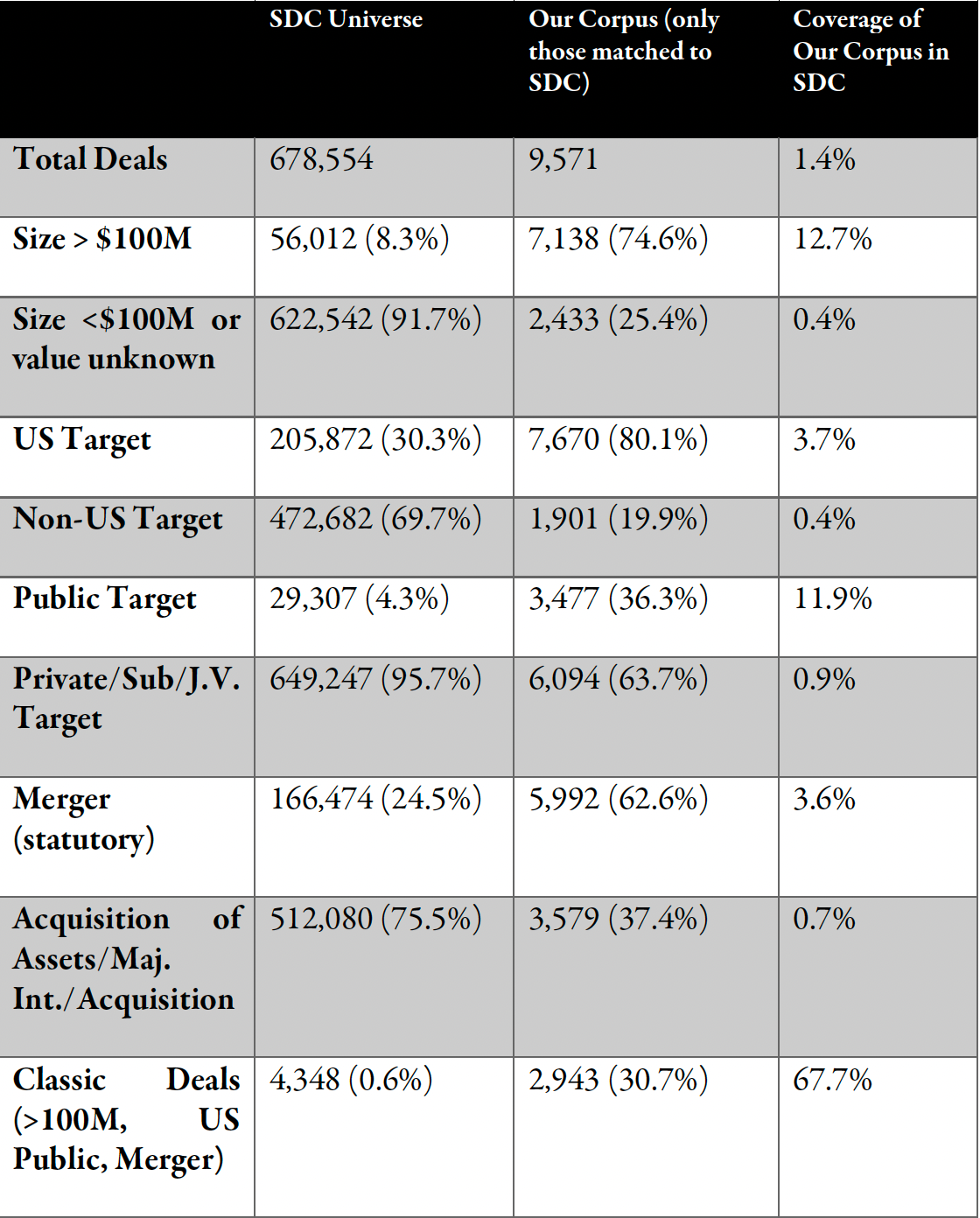
“The most comprehensive” but not actually “comprehensive.” We fuzzy-matched our corpus against SDC Platinum’s ~679,000 completed transactions. What resulted revealed the bias that comes from deals that get filed and are recoverable from EDGAR. Our sample is much more likely to contain larger deals between domestic firms, and less likely to contain asset acquisitions. But, at the intersection of size, geography, target status, and form — a $100 million-plus acquisition of a U.S. public target by statutory merger — our coverage of the universe is 68 percent.
Then, in a move regular readers should find familiar, we used Claude Code to create a Python script that uses Haiku 4.5 to re-code variables for each contract, with the hand-coded variables as training/validation data.1 An ex post blind hand-audit of broad arbitration clauses found 100% agreement between human and LLM coding.2 And Claude+Haiku was much better than human-coding at avoiding type II error. This is why I’m optimistic about the near-term future of legal scholarship. There’s just no way we could have gotten this paper over the finished line with AI.3
The dataset and all supporting materials, including replication scripts, are on GitHub. Go play with it!4
The Headline: ~8.6%, Forever
About 8.6% of all deals in our sample elect arbitration for dispute resolution, a number that is essentially unchanged over twenty-five years.
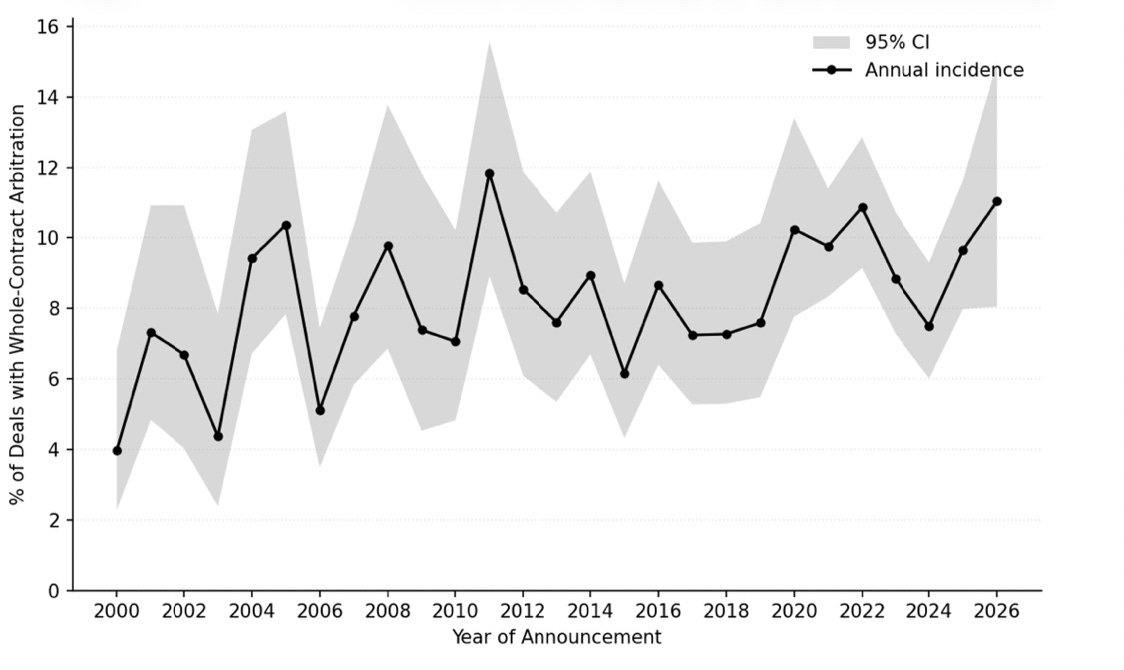
Now, if you squint hard enough at these data, you might conclude that there is a time trend, a slow increase arbitration’s use. But that apparent trend is an artifact of shifting composition of the underlying sample. The share of small private targets in the corpus of available M&A contracts has grown by ~23 percentage points, and private targets are five times more likely than public targets to include arbitration (13.1% versus 2.5%).
That is, within both private-target and public-target subsets, observed arbitration rates have been stable or slightly declining. The apparently modest rise in the sample-wide arbitration rate — from 7.77% to 9.22% — is entirely a compositional artifact of how our sample gradually pulled in more private-target deals.
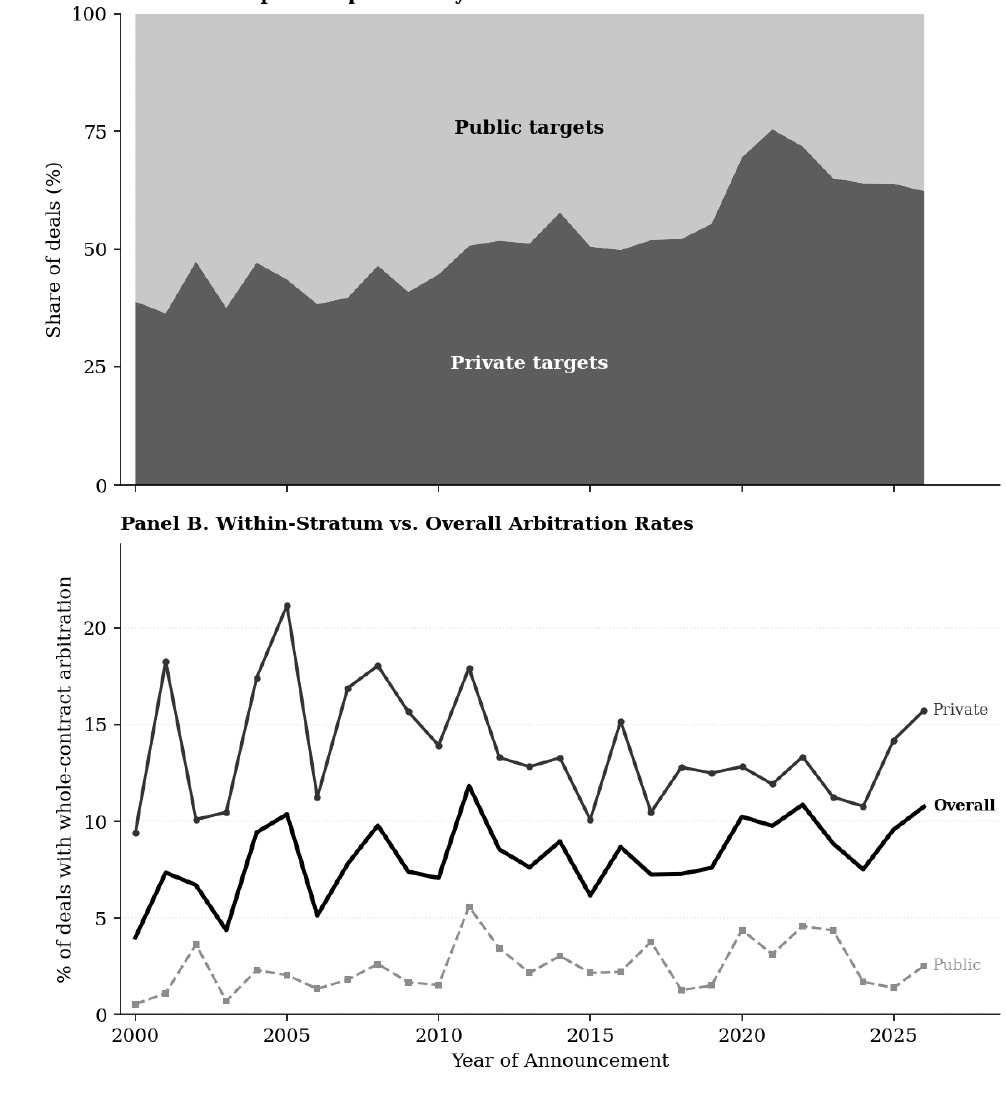
So, in every substantive corner of the domestic market that we can observe, the parties’ arbitration behavior has not budged. We ran some robustness checks to see whether the deals that we can’t observe are likely to look different on arbitration use, and we end up concluding they don’t. And that’s true despite quite avulsive changes in the market for M&A over the last twenty-five years.
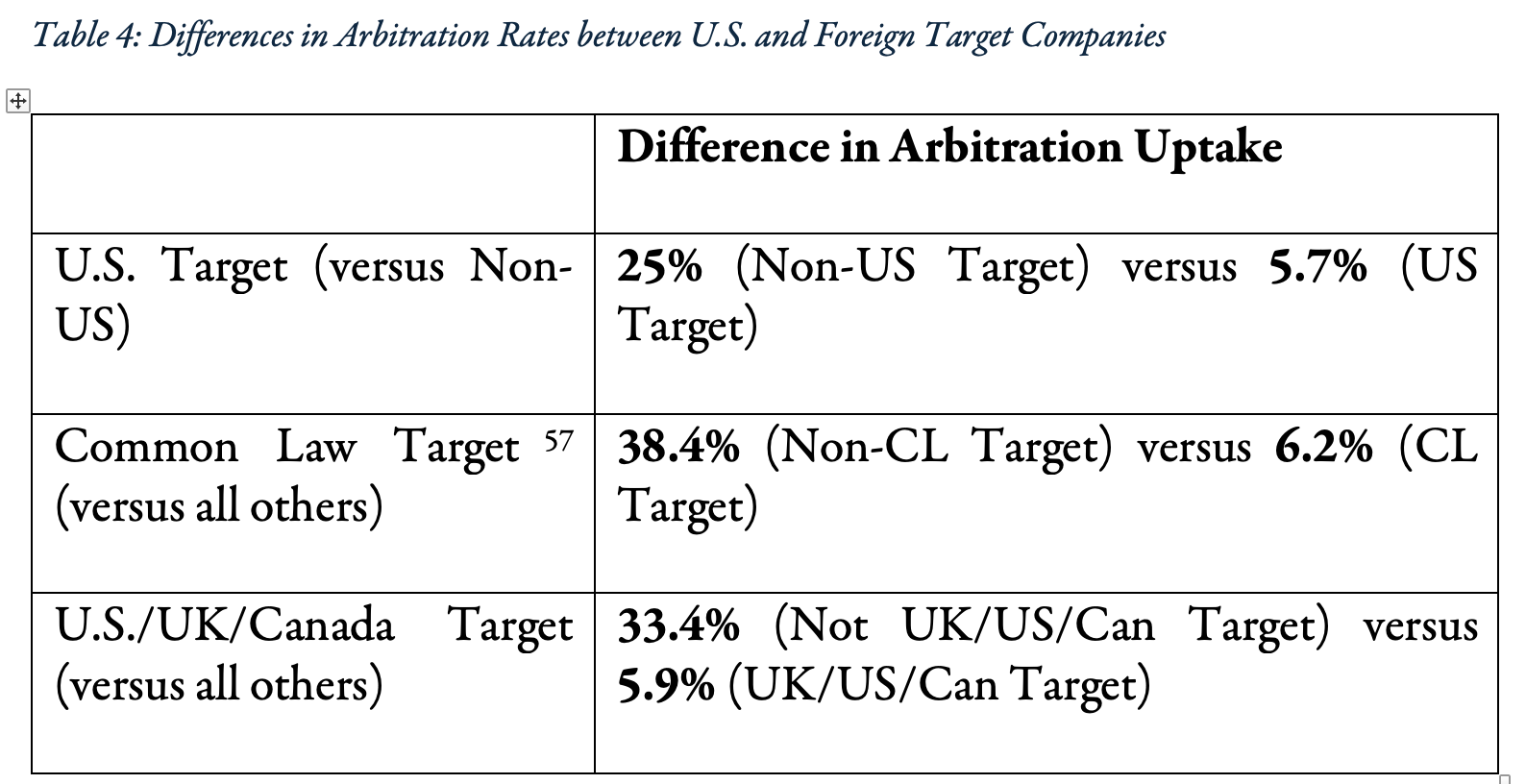
We find that arbitration in domestic M&A simply isn’t very common, but it is quite related to the identity of the target. When a US acquiring party contracts with a target that is located outside of common law jurisdictions, they arbitrate alot — almost half the time. But when US firms buy Canadian or UK firms, they don’t. And domestic M&A is mostly (and increasingly) concentrated in Delaware’s Chancery court.
Stability in arbitration’s uptake at this low rate over time is a little odd. Consider what’s happened in consumer and employment arbitration over the same period: Concepcion, mass-arbitration tactics, a continuous tug-of-war between federal and state law over enforceability. By contrast, in the corner of the contracting universe occupied by sophisticated M&A practice, the equilibrium has been set for two decades.
What the Lawyers Told Us
To dig into these data, we interviewed transactional and litigation/arbitration lawyers. They told us that parties choose courts precisely because courtrooms are public. As one interviewee put it: “There’s an in terrorem effect of having a public lawsuit filed, especially if I’m on the buy side and I feel like I’ve been defrauded . . . . [If I threaten to file a suit], the odds are you’re going to get into a room and talk to me . . . There’s something very real and visceral about being sued for fraud in court.” Almost no M&A dispute is adjudicated to judgment, and every M&A dispute is bargained in some forum’s shadow.
Second, they trust Delaware and its remedial regime, and distrust nearly everyone else. One lawyer, on a Kentucky deal that drew the inevitable shareholder litigation, consulted local counsel about the judge: “We did a little looking, this guy has never tried an M&A case ever . . . And he just started a criminal jury trial which is likely to go three to four weeks. So he’s gonna deal with this case in his off time. And . . . he might issue a TRO just because can’t deal with it right now.” Another was blunter: “Let’s not kid ourselves, Delaware has a huge advantage because you can get specific performance. Not at all clear that you can get in the other 49 states.”
What was particularly interesting was commentary we heard praising the situation sense of the chancery court in SaveMart, a decision in which Chancery “reluctantly” confirmed an arbitrator’s award. (The award was written by former VC Slights!) VC Laster, though concluding that the award ought to stand, wrote that thought a literal reading of the deal was not appropriate under the circumstances. The “ outcome that the Buyer achieved in this case was . . . economically divorced from the intended transaction,” and he “would have ruled differently than the Arbitrator.” Our respondents thought that this kind of deal sense was hard to find outside of Delaware, and a core part of what it offers.
For localized deals where Delaware doesn’t come to mind, arbitration is the fallback — “As compared between going in front of a North Carolina judge who has never seen an M&A agreement before, wouldn’t it be better to put some boundaries around the skillset of the arbitrator?”
Third some deal lawyers admitted they don’t read the dispute resolution provision at all. Asked whether it was possible people simply skip it: “Yeah! It’s way in the back!” But inattention at the deal level is, we argue, evidence of a settled equilibrium: the clause in any given deal may go unread, but the template it came from did not write itself. The deal lawyer who skims the back of the agreement is relying on a choice already made, much as a pilot relies on a checklist she did not draft.
Adjudication Is a Product
After working through this evidence, we turn to theory. We recast adjudication as a product defined by multiple characteristics, not only substantive law but also adjudicator precision, speed, impartiality, remedies, publicity, and discovery. Forums differ not only in how they score on each characteristic but in how tightly the characteristics are coupled to one another. Here’s a sort of hand-wavey summary of our argument.
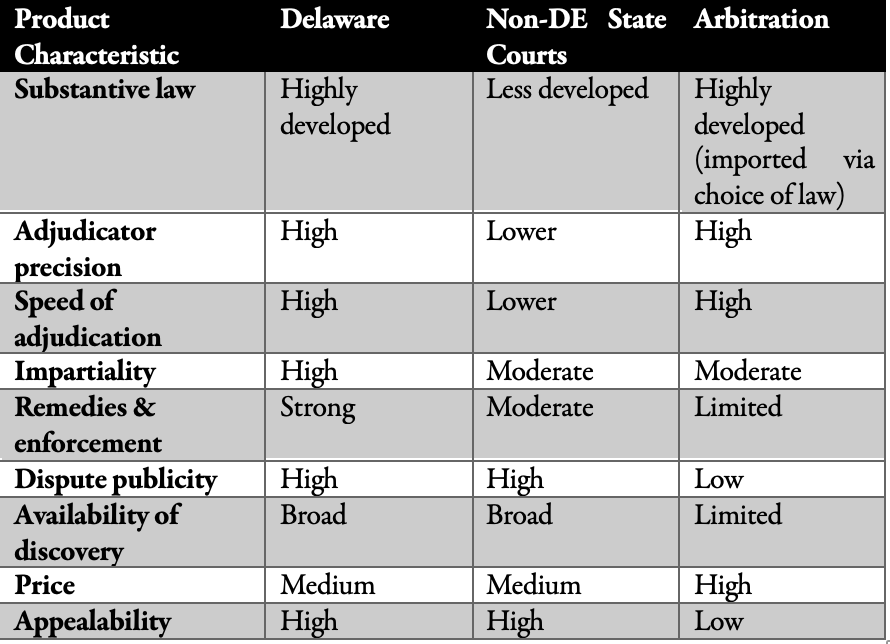
Delaware sells an integrated package whose components work together as a cohesive, high-quality unit — like a flagship Apple iPhone, whose hardware, software, and services are designed to one another’s specification. It’s a flywheel. Delaware’s judges are expert in part because a dense body of caselaw guides them. The caselaw is dense because Delaware handles a high volume of complex disputes. The disputes arrive because practitioners trust the judges. And so it goes.
The coupling mechanism is precedent. Adjudication yields two outputs at once. It resolves the dispute at hand, a private good the parties pay for by paying lawyers, and precedent, a public good that future parties consume without paying. Every dispute the parties send to Chancery does double duty; every dispute sent to arbitration consumes that stock while contributing nothing back. The ninety-plus percent of parties who choose courts are, whether they mean to or not, financing the commons on which the entire equilibrium runs. Which means Delaware’s bundle cannot be easily assembled by an entrant at any price: a rival can hire talented judges and write expedition rules, but it will prove harder to buy a credible commitment to a generation or more of decided cases, particularly the court’s commitment to finding the real deal and enforcing it with equitable relief.
Delaware’s competitors — other states’ courts and private arbitration — sell something else: modularity. Pieces that parties can select among, combine, and reconfigure as their needs change. And the framework generates testable predictions: as a non-Delaware court’s expertise matures (e.g., the Texas Business Court), arbitration’s incidence in that segment should fall without any migration in governing law. If ever-larger deals find the modular stack good enough, Delaware will be disrupted in Christensen’s precise sense, however secure its share of headline deals appears in any cross-section.
Neither formalism, nor the content of the law, nor speed, nor coercive force alone has a chance of dethroning Chancery in its M&A heartland. Only the whole bundle does, and it’s not obviously for sale.
The paper is here; the data are here; comments very welcome — especially from readers who’ve drafted one of the 8.6%.
In fact, we spent most of a year trying to do this with a variety of other methods, including hand-coding.
This audit was brilliantly accomplished by Penn 2L Will Driscoll.
One practice pointer, as they say. I asked Claude to compile a STATA do file to match the python code because I thought law review editors would prefer it. This was a disaster. Do not do this.
And then cite us.
While I may have substantive comments eventually, just FYI: your link to your paper currently points to "https://claude.ai/cowork/SSRN-LINK-HERE," rather than SSRN. I enjoyed the paper, so would like to encourage a higher readership.