

Wrestling’s Old-Time Contract Religion
Ritual, commitment, and the work contracts once performed

I was a big fan of professional wrestling growing up.1 I unironically liked every bit of it, not least the promos. And I definitely thought it was real.
Consider this 1987 promo. It's got my two favorites as a kid — Andre the Giant and the Hulk. And it raises all kinds of great contract questions, including “is the belt conversation parol evidence?” and, “what is the significance of signing in blood?”
I stopped watching WWF in the early 1990s, but the schtick remains vital to the present day.2 Here—as elsewhere—wrestling’s contract kayfabe is a more interesting cultural artifact than it first appears. Indeed, this is one of the few places in American life where actually signing a paper contract remains important as a spectacle. Elsewhere, from home mortgages to car purchases to the rules of engagement in the town square, we’re left to click and agree. Wrestling preserves an old ritual of engaging with commercial life that’s all but extinct.
What’s interesting here is not that wrestling treats contracts seriously, but that it still relies on them to do a kind of work most modern agreements no longer do.
For wrestling, the ceremony is important to the audience and the participants — everyone knows that the signature marks a moment of real commitment—a moment that explains what comes next. That is, putting your name on the page ends a bunch of questions about whether the match will happen or on what terms. The fact that the entire thing is fake is obviously not important: the contract signing ceremony is part of the fantasy’s rules.
Now, even putting aside the fact that no one signs anything anymore, wrestling’s view of contract law is not true to doctrine, as signing isn’t necessarily formation, and breach is a normal part of contracting life. But it does capture folk contract law.
Folk contract law sits alongside formal law.3 In it, signatures and writings govern, and obligation is marked by ritual.
I’ve often thought about the famous Lucy v. Zehmer case in this way. In Lucy, as those who remember 1L contracts will recall, two parties meet at a bar, get as “high as a georgia pine,” and conclude a real estate sale. The seller later disclaimed obligation, saying the deal was a joke. The Court rejected that defense, boggled by the idea that contracts could be funny.
But the more interesting part of the case is what happened after the parties had signed the note that memorialized their transaction:
On examination by [the seller’s own counsel, Mrs. Zehmer] said that her husband laid this piece of paper down after it was signed; that Lucy said to let him see it, took it, folded it and put it in his wallet, then said to Zehmer, "Let me give you $5.00," but Zehmer said, "No, this is liquor talking. I don't want to sell the farm, I have told you that I want my son to have it. This is all a joke." Lucy then said at least twice, "Zehmer, you have sold your farm," wheeled around and started for the door.
What work is that $5 doing? It’s not consideration in any doctrinal sense. And it’s not payment.
I think it represents a folk view about how you memorialize a deal—a consideration substitute like a seal, shaking hands, or signing with a flourish. Like keyfabe’s signing ceremonies, it represents something that the culture wants out of contract, but that it no longer provides.
I’ve written some about the loss of contracts’ moral signal. But the story I’ve told was about an excess of text: we have too many contracts. When you signed one or two contracts a month, it meant something. When you click to agree to a thousand, it doesn’t.
That bloat story is incomplete. One idea worth considering is that modern contract’s rituals just aren’t doing the work they used to. The question isn’t whether contracts still bind. It’s whether they still teach—whether they still tell ordinary people when obligation begins, when flexibility ends, and when an argument is supposed to be over. That teaching once happened through visible moments—signing, sealing, handing over a token—that made commitment feel real even to people who never read the text.
For contract, it’s clear that text alone is no longer a culturally plausible way to govern ordinary behavior.
For most of contract law’s history, written agreements didn’t just allocate remedies in the background. They helped structure day-to-day conduct. People went back to them—sometimes literally, more often loosely—to figure out what compliance looked like, when deviation was tolerated, and when it wasn’t. To be clear, that’s not because anyone carefully read the document before signing. Rather, reading during the life of the relationship was normal enough to do that kind of work.
That world is mostly gone.
Firms know this. They no longer expect contracts to discipline behavior. They expect design (billing, access) to do that work instead. Defaults, friction, and irreversible flows govern conduct increasingly without expecting anyone to read anything at all.
Often, this works better than text ever did. But it governs without the moral vocabulary of consent that contract traditionally supplied. And that difference shows up when things go wrong. Disputes that might once have been absorbed into private ordering increasingly migrate outward—to regulators, courts, and public law—because there is less shared understanding of what anyone agreed to in the first place.
This produces a slightly odd equilibrium. People remain formalists about contracts, and believe written terms are binding. But those beliefs aren’t produced by reading contracts. They’re produced by living in a world saturated with rigid, unread text and mechanical enforcement.
Which brings us back to wrestling.
The contract-signing ceremony sticks around because people like it: it still feels meaningful.
Nothing about modern commercial life should support that intuition anymore. Nobody signs or reads, and obligation is managed through interfaces, defaults, and algorithmic scripts. Yet the idea that writing your name on a page does something hasn’t gone away. The wrestling signing ceremony preserves an older way of thinking about contract. In that old world, writing, formality, and commitment lined up in a way ordinary people recognized. This was an alignment contract law once relied on, even as its actual operations have moved elsewhere.
Modern contracting practice—and much of modern doctrine—pretends this folk understanding no longer matters. Or that it’s naïve. Wrestling suggests otherwise. The old religion still has power, even if the institutions built on it no longer quite know how to speak its language.
Also: monster trucks. What a country!
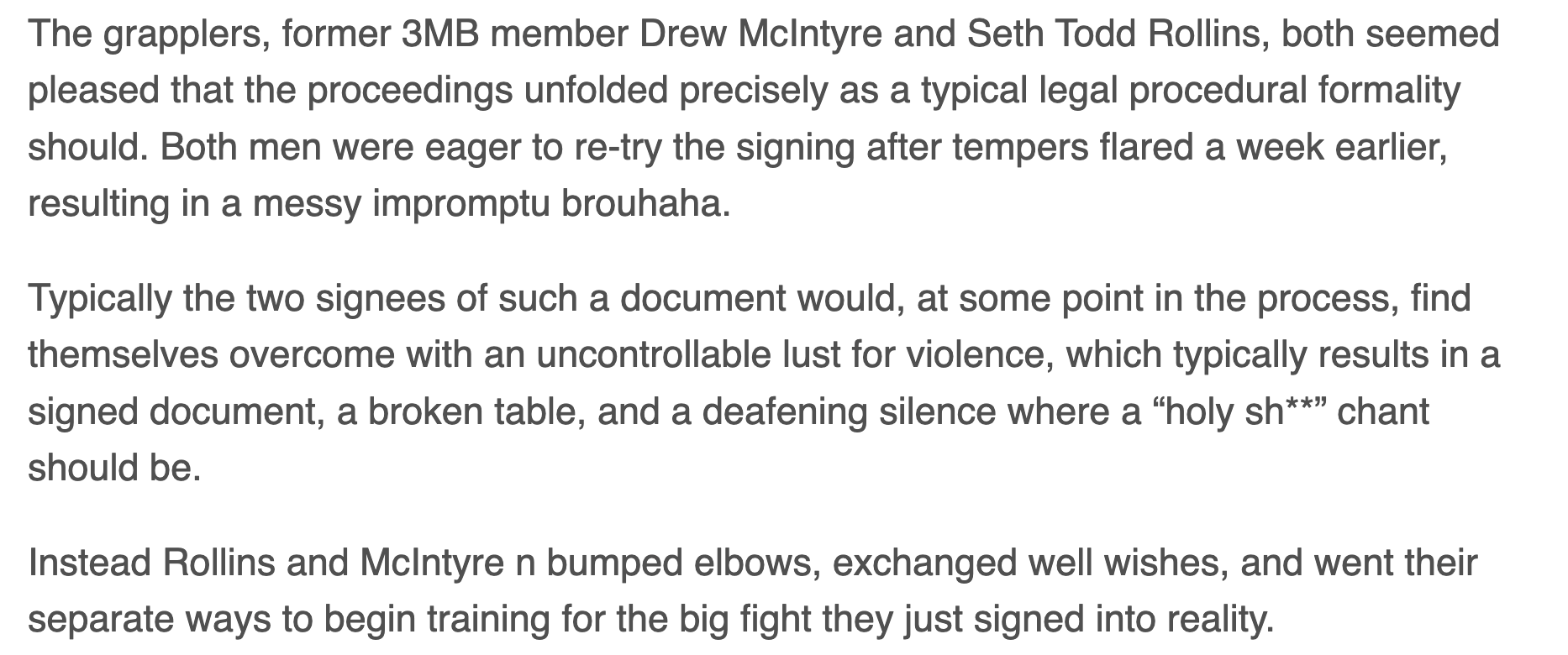
You can find listicles for the greatest signing ceremonies, questions about their relevance today, and some pretty funny social commentary on meaning of the angle. To wit:
Like the wild cosmology of Cheese and the Worms.
"People remain formalists about contracts, and believe written terms are binding. But those beliefs aren’t produced by reading contracts. They’re produced by living in a world saturated with rigid, unread text and mechanical enforcement."
Well said, and it scares me profoundly. Binding contracts being presented digitally in a way that's increasingly irrational to read creates the worst kind of mutual vulnerability.